
Evidence based assessment of Low back pain

Author
Physiotherapy Online
About Physiotherapy Online
Physiotherapy Online is a physiotherapist-owned educational company with a vision to create an ensemble of international educators to cater to undergraduate, postgraduate physiotherapy students as well as post professionals who are keen to advance or refesh their existing knowledge in varied specialities.
As every student has a unique approach to learning, we have therefore created a library of bite sized chapters which may be accessed as an individual module or a course as a whole; self study webinars; live workshops for those who would like to get an in-person hands on immersive experience and audio books for those on the go.
Course Description
This course reframes low back pain through a biopsychosocial lens, integrating epidemiology, pain science, and the global burden of LBP to explain why patients present so differently. Participants will explore how beliefs, behavior's, and psychosocial drivers shape pain and disability, using validated tools such as the FABQ, BBQ and TSK to sharpen clinical decision‑making.
What you will learn
- You will learn to apply evidence‑based risk stratification, including red flag screening and the Start Back Tool, to confidently differentiate serious pathology from routine presentations.
- course guides clinicians in interpreting movement, functional and psychosocial findings within a structured clinical reasoning framework
- synthesizing complex information into clear, proportionate, patient‑centered management plans
- Through practical examples and case‑based reasoning, participants will strengthen their ability to navigate uncertainty and clinical complexity.
- you will be equipped with a modern, evidence‑informed approach to assessing and managing low back pain with clarity and confidence.
Course Objectives:
- Analyze low back pain using a biopsychosocial framework, integrating epidemiology, pain science principles, and the burden of LBP to explain variations in patient presentation and outcomes.
- Evaluate the influence of beliefs, behavior's, and psychosocial factors on pain and disability, using validated screening tools (FABQ, BBQ, TSK) to inform clinical decision‑making.
- Apply evidence‑based risk stratification and screening approaches, including red flag assessment and the Start Back Screening Tool, to distinguish serious pathology and guide management pathways.
- Synthesize findings from movement, functional, and psychosocial assessment within a structured clinical reasoning framework to develop proportionate, patient‑centered management strategies.
Who can Enroll:
- Physiotherapist
- Musculoskeletal Physiotherapist
- Physiotherapy Assistant
Duration: 1.5 hr
Dr Kavitha Vishal PT PhD is an Assistant Professor (Selection Grade) in the Department of Physiotherapy at Manipal College of Health Professions, Manipal Academy of Higher Education (MAHE),India. She specializes in Musculoskeletal Physiotherapy and holds a PhD focused on sensorimotor training in rotator cuff–related shoulder pain. Her research interests include designing optimal management approaches for shoulder disorders, understanding sensorimotor impairments following upper‑quadrant musculoskeletal pain, neuroplasticity, chronic musculoskeletal pain, and developing normative data for upper extremity outcome measures. She has published 22 peer‑reviewed articles and serves as an Editorial Board Member for BMC Sports Science, Medicine and Rehabilitation. She is also a member of the Developing Countries Working Group of the International Association for the Study of Pain (IASP) for the 2024–2026 term.
Disclaimer: Our online physiotherapy CPD courses meet the criteria and guidelines for CPD (Continuing Professional Development). The CPD hours indicated on the certificate contribute towards fulfilling professional standards and requirements necessary for CPD audits conducted by the HCPC and AHPRA. These CPD hours are important for maintaining physiotherapy registration and ensuring compliance with the CPD audit and physiotherapy registration renewal processes. Our courses are recognized as valuable continuing education resources across the UK, Australia, New Zealand, and throughout Asia and the Middle East
Course program


Certificate
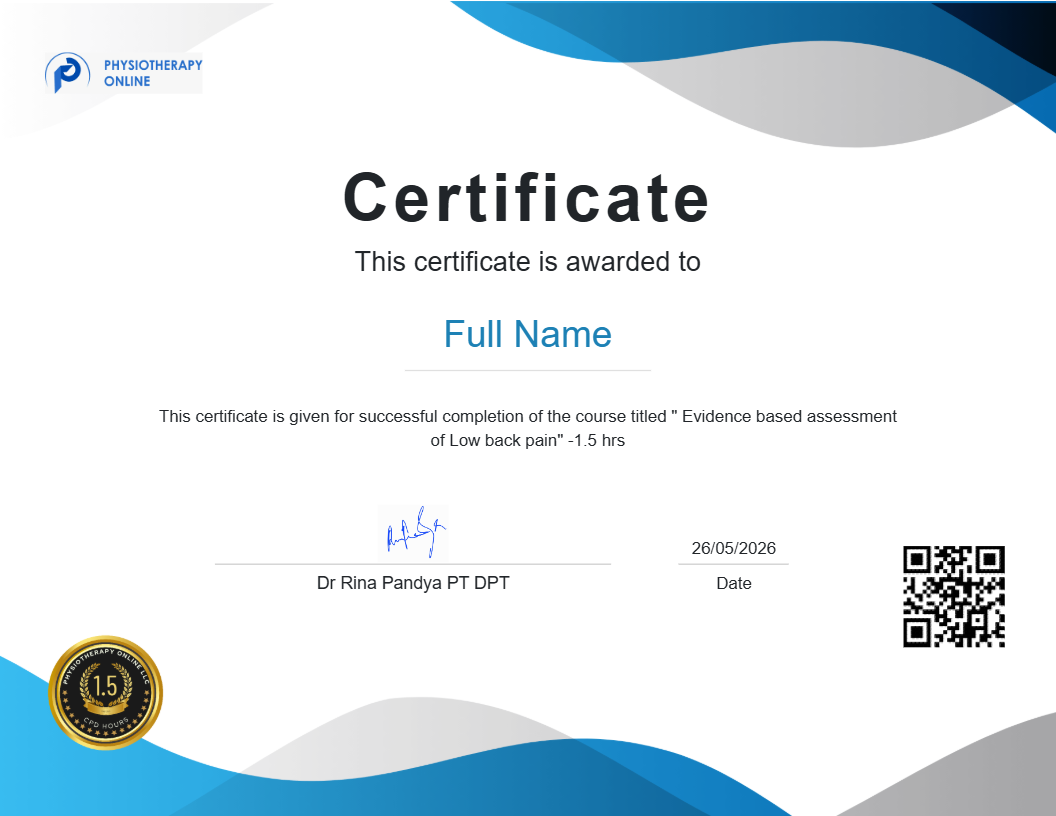
A certificate is given at the end of the course.

The course will be available 30 Day
Evidence based assessment of Low back pain
Author
Physiotherapy Online
About Physiotherapy Online
Physiotherapy Online is a physiotherapist-owned educational company with a vision to create an ensemble of international educators to cater to undergraduate, postgraduate physiotherapy students as well as post professionals who are keen to advance or refesh their existing knowledge in varied specialities.
As every student has a unique approach to learning, we have therefore created a library of bite sized chapters which may be accessed as an individual module or a course as a whole; self study webinars; live workshops for those who would like to get an in-person hands on immersive experience and audio books for those on the go.
