
Concussion and Post-Concussion Syndrome
Author
Physiotherapy Online
About Physiotherapy Online
Physiotherapy Online is a physiotherapist-owned educational company with a vision to create an ensemble of international educators to cater to undergraduate, postgraduate physiotherapy students as well as post professionals who are keen to advance or refesh their existing knowledge in varied specialities.
As every student has a unique approach to learning, we have therefore created a library of bite sized chapters which may be accessed as an individual module or a course as a whole; self study webinars; live workshops for those who would like to get an in-person hands on immersive experience and audio books for those on the go.
Description:
Concussion and mild traumatic brain injury (mTBI) present with complex, multisystem impairments that require precise clinical reasoning and coordinated rehabilitation. This course equips physiotherapists with an advanced, evidence‑based framework to assess, classify, and treat concussion across all clinical subtypes, with a strong emphasis on vestibular, oculomotor, cervical, exertional, and autonomic domains.
Participants will explore the pathophysiology, epidemiology, and clinical classification of concussion/mTBI, including mechanisms of injury, neurophysiological changes, and the risk factors associated with persistent post‑concussion symptoms. A structured assessment model guides clinicians through systematic screening of vestibular and oculomotor dysfunction, cervical contributions, exercise intolerance, and autonomic dysregulation—allowing accurate identification of the patient’s dominant clinical subtype.
Building on this foundation, the course provides a subtype‑specific rehabilitation approach, integrating vestibular therapy, cervical management, visual‑vestibular retraining, autonomic regulation strategies, and graded exertion protocols. Clinicians will learn how to design individualized treatment plans that progress safely from symptom‑limited activity to full functional participation.
Current return‑to‑sport, return‑to‑learn, and return‑to‑work guidelines are translated into practical decision‑making tools, ensuring clinicians can support patients through staged recovery while recognizing red flags that require medical referral or interdisciplinary management.
By the end of the course, participants will be able to deliver confident, structured, and evidence‑informed concussion rehabilitation that improves patient outcomes, reduces chronicity, and supports safe return to daily life, sport, and work.
Learning Outcomes:
- Describe the pathophysiology, epidemiology, and clinical classification of concussion/mTBI, including risk factors for persistent symptoms.
- Apply a systematic vestibular, oculomotor, cervical, exertional, and autonomic assessment framework to identify clinical subtypes.
- Design a subtype-specific rehabilitation program integrating vestibular therapy, cervical treatment, and graded exertion protocols.
- Apply current return-to-sport, return-to-learn, and return-to-work protocols, and recognize red flags requiring referral.
Audience:
- Physiotherapists
- Occupational Therapists
- Doctor of Physiotherapists
- Musculoskeletal Physiotherapists
- Neurological Physiotherapists
- Physiotherapy Assistant
Duration:
1.5 hrs
Level:
Intermediate
Speaker:
Dr. Rina Pandya, PT, DPT, FHEA, PGLTHE is an internationally recognised Doctor of Physical Therapy and Senior Lecturer in Physiotherapy at the University of the West of England (UWE),with over 25 years of clinical experience. She obtained her entry‑level physiotherapy degree from the School of Allied Health Sciences, Manipal, India, and her post‑professional Doctor of Physical Therapy degree from the University of Michigan‑Flint, USA. Dr. Pandya has worked clinically and in rehabilitation leadership roles across India, Oman, the United Kingdom, and the United States, giving her a strong global perspective on healthcare systems and patient care. A committed educator and advocate for lifelong learning, she holds a Fellowship in Higher Education (FHEA) and a Postgraduate Certificate in Learning and Teaching in Higher Education (PGLTHE),and has completed formal training in research methods at the Manchester School of Physiotherapy. Her expertise spans evidence‑based practice, clinical guideline synthesis, workflow automation, and learner‑centred design. Dr. Pandya is a global CPD presenter and has developed internationally aligned modules, over 95 webinars, and clinical assessment tools that empower clinicians with practical approaches to clinical reasoning, documentation, and lifelong learning.
Disclaimer: Our online physiotherapy CPD courses meet the criteria and guidelines for CPD (Continuing Professional Development). The CPD hours indicated on the certificate contribute towards fulfilling professional standards and requirements necessary for CPD audits conducted by the HCPC and AHPRA. These CPD hours are important for maintaining physiotherapy registration and ensuring compliance with the CPD audit and physiotherapy registration renewal processes. Our courses are recognised as valuable continuing education resources across the UK, Australia, New Zealand, and throughout Asia and the Middle East
Course program


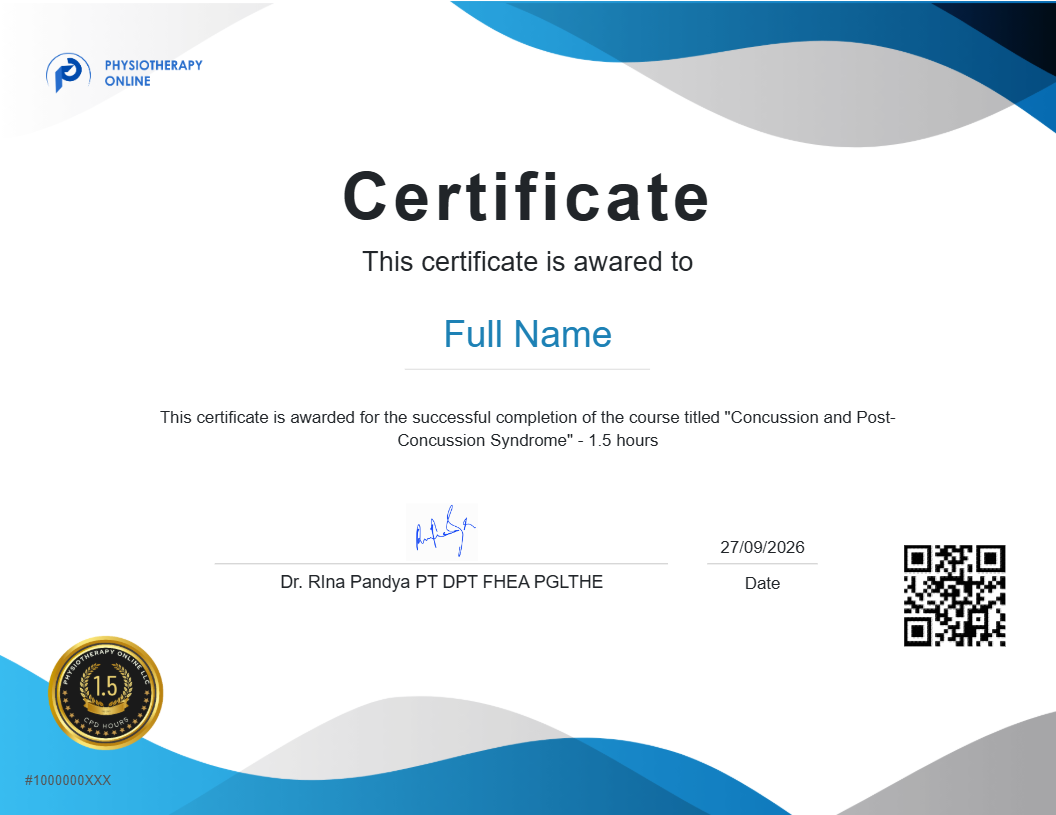
Certificate
A certificate is given at the end of the course.
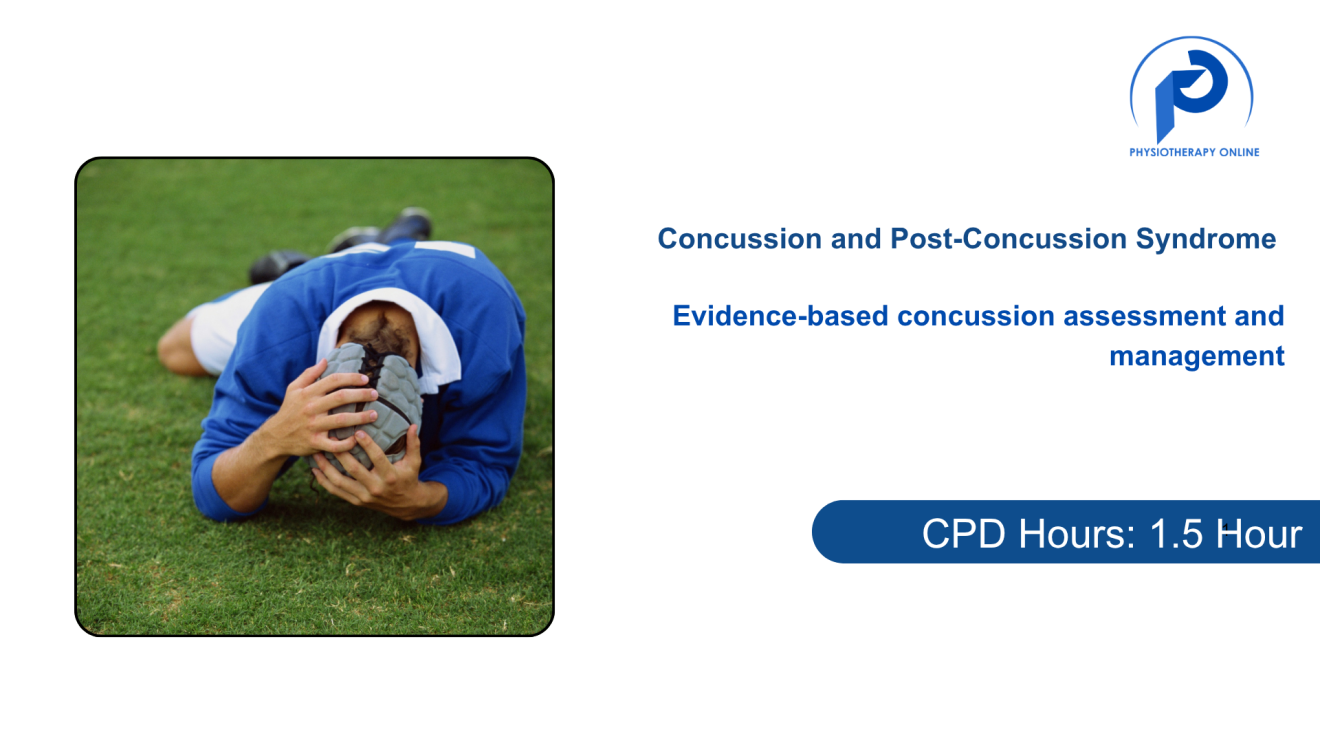
The course will be available 30 Day
Concussion and Post-Concussion Syndrome
Author
Physiotherapy Online
About Physiotherapy Online
Physiotherapy Online is a physiotherapist-owned educational company with a vision to create an ensemble of international educators to cater to undergraduate, postgraduate physiotherapy students as well as post professionals who are keen to advance or refesh their existing knowledge in varied specialities.
As every student has a unique approach to learning, we have therefore created a library of bite sized chapters which may be accessed as an individual module or a course as a whole; self study webinars; live workshops for those who would like to get an in-person hands on immersive experience and audio books for those on the go.
