
Evidence-based low back pain Rehabilitation and management strategies.

Author
Physiotherapy Online
About Physiotherapy Online
Physiotherapy Online is a physiotherapist-owned educational company with a vision to create an ensemble of international educators to cater to undergraduate, postgraduate physiotherapy students as well as post professionals who are keen to advance or refesh their existing knowledge in varied specialities.
As every student has a unique approach to learning, we have therefore created a library of bite sized chapters which may be accessed as an individual module or a course as a whole; self study webinars; live workshops for those who would like to get an in-person hands on immersive experience and audio books for those on the go.
Course description:
This course equips clinicians with a modern, guideline‑aligned approach to managing low back pain, drawing on APTA, NICE, WHO and European recommendations.
What you will learn:
- You will learn how targeted pain science education can reduce fear, correct misconceptions and shift maladaptive coping in people with persistent symptoms.
- The course develops your ability to select and justify exercise‑based interventions—from motor control to strengthening to graded activity—based on individual presentation, risk stratification and functional goals.
- You will refine skills in recognising fear-avoidant behaviours and central sensitisation, integrating behavioural strategies and graded exposure to support confident movement and recovery.
- Manual therapy is presented as a purposeful adjunct, used selectively within a broader, evidence‑informed, multidisciplinary plan.
- Case‑based reasoning strengthens your clinical judgement around when to progress exercise, integrate behavioural approaches, apply manual therapy or collaborate with other professionals
6. Clinicians will be able to deliver coherent, patient-centred management plans that reflect the strongest international guidance for persistent low back pain.
Course Objectives:
- Critically appraise the role of education as a treatment in low back pain, explaining how pain science education can address fear, misconceptions, and maladaptive coping in people with persistent pain.
- Select and justify appropriate exercise‑based interventions (motor control, strengthening, graded activity) based on patient presentation, risk stratification, and functional goals.
- Identify and address fear-avoidant behaviours and central sensitisation, integrating behavioural strategies and graded exposure principles to support recovery in individuals with persistent low back pain.
- Integrate manual therapy as an adjunct within a broader, evidence‑informed multidisciplinary management approach, using clinical reasoning to determine when referral or collaboration with other healthcare professionals is indicated.
Duration: 1.5 hr
Who should attend?
- Physiotherapists
- Musculoskeletal Physiotherapists
- Physiotherapy Assistants
Speaker:
Dr. Rina Pandya, PT, DPT, FHEA, PGLTHE is an internationally recognised Doctor of Physical Therapy and Senior Lecturer in Physiotherapy at the University of the West of England (UWE),with over 25 years of clinical experience. She obtained her entry‑level physiotherapy degree from the School of Allied Health Sciences, Manipal, India, and her post‑professional Doctor of Physical Therapy degree from the University of Michigan‑Flint, USA. Dr. Pandya has worked clinically and in rehabilitation leadership roles across India, Oman, the United Kingdom, and the United States, giving her a strong global perspective on healthcare systems and patient care. A committed educator and advocate for lifelong learning, she holds a Fellowship in Higher Education (FHEA) and a Postgraduate Certificate in Learning and Teaching in Higher Education (PGLTHE),and has completed formal training in research methods at the Manchester School of Physiotherapy. Her expertise spans evidence‑based practice, clinical guideline synthesis, workflow automation, and learner‑centred design. Dr. Pandya is a global CPD presenter and has developed internationally aligned modules, over 95 webinars, and clinical assessment tools that empower clinicians with practical approaches to clinical reasoning, documentation, and lifelong learning.
Disclaimer: Our online physiotherapy CPD courses meet the criteria and guidelines for CPD (Continuing Professional Development). The CPD hours indicated on the certificate contribute towards fulfilling professional standards and requirements necessary for CPD audits conducted by the HCPC and AHPRA. These CPD hours are important for maintaining physiotherapy registration and ensuring compliance with the CPD audit and physiotherapy registration renewal processes. Our courses are recognised as valuable continuing education resources across the UK, Australia, New Zealand, and throughout Asia and the Middle East
Course program


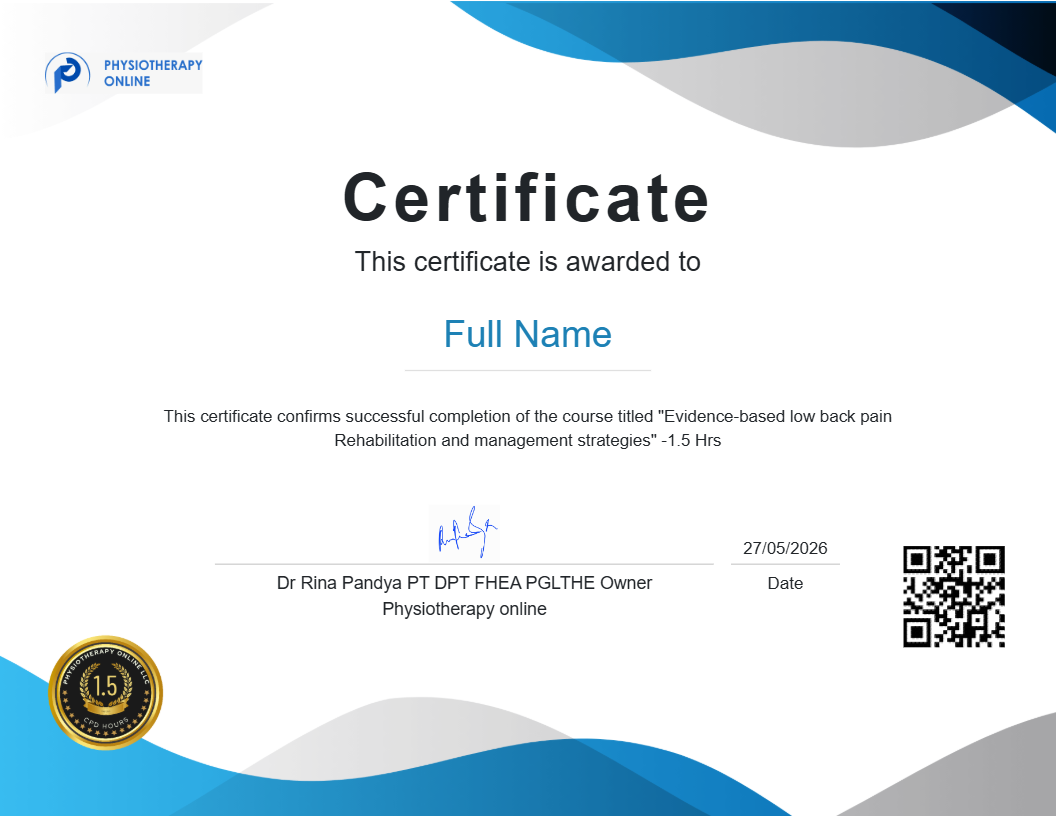
Certificate
A certificate is given at the end of the course.
The course will be available 30 Day
Evidence-based low back pain Rehabilitation and management strategies.
Author
Physiotherapy Online
About Physiotherapy Online
Physiotherapy Online is a physiotherapist-owned educational company with a vision to create an ensemble of international educators to cater to undergraduate, postgraduate physiotherapy students as well as post professionals who are keen to advance or refesh their existing knowledge in varied specialities.
As every student has a unique approach to learning, we have therefore created a library of bite sized chapters which may be accessed as an individual module or a course as a whole; self study webinars; live workshops for those who would like to get an in-person hands on immersive experience and audio books for those on the go.
