
Mastering TBI rehabilitation: Evidence-based Course For Physiotherapists
Author
Physiotherapy Online
About Physiotherapy Online
Physiotherapy Online is a physiotherapist-owned educational company with a vision to create an ensemble of international educators to cater to undergraduate, postgraduate physiotherapy students as well as post professionals who are keen to advance or refesh their existing knowledge in varied specialities.
As every student has a unique approach to learning, we have therefore created a library of bite sized chapters which may be accessed as an individual module or a course as a whole; self study webinars; live workshops for those who would like to get an in-person hands on immersive experience and audio books for those on the go.
This comprehensive continuing professional development (CPD) course offers a rigorous, evidence-based framework for the physiotherapy management of individuals with moderate-to-severe Traumatic Brain Injury (TBI). Designed for basic to intermediate level clinicians, the curriculum progresses from foundational clinical analysis to advanced neurorehabilitation techniques. You will master the process of TBI classification using key objective markers, including the Glasgow Coma Scale (GCS) and the duration of Post-Traumatic Amnesia (PTA),which is a critical predictor of functional outcome.
The course emphasizes early intervention, covering essential acute care strategies such as respiratory management and specialized positional care to proactively prevent devastating secondary complications like muscle contractures and heterotopic ossification (HO). A core focus is placed on the differential diagnosis of hypertonus, utilizing tools like the Modified Tardieu Scale to distinguish between velocity-dependent spasticity and fixed structural contracture. Based on this assessment, you will develop integrated treatment plans that combine mechanical interventions, such as serial casting, with pharmacological adjuncts like Botulinum Toxin (Botox),ensuring goal-directed, functional improvement.
Finally, the course details advanced rehabilitation methodology, including the provision of active therapy during the PTA phase in line with INCOG guidelines. You will learn to design and implement high-intensity, task-specific mobility training protocols, including evidence-based ballistic resistance training, to maximize walking speed and functional independence. The program concludes with strategies for promoting long-term cardiorespiratory fitness, which is essential for mitigating secondary health risks (e.g., heart disease and diabetes) and successfully facilitating community reintegration for TBI survivors.
Course Objectives
- Analyze moderate-to-severe TBI systems using GCS and PTA clinical markers.
- Apply evidence-based respiratory and positional care to prevent secondary complications.
- Differentiate hypertonus types and develop integrated plans with serial casting and meds.
- Design high-intensity mobility training and promote long-term fitness for survivors.
Duration:
1.5 Hours
Who can enrol:
- PT
- PTA
- COTA
- Cancer nurses
- Rehabilitation Therapists
Author: Dr Rina Pandya, PT , DPT, FHEA, PGLTHE
Dr. Rina Pandya is a highly experienced physical therapist with a diverse international background. She earned her entry-level degree from the School of Allied Health Sciences Manipal, India, and her post-professional doctoral degree from the University of Michigan-Flint.
With extensive clinical experience across India, Oman, the UK, and the USA, Dr. Pandya brings a rich, global perspective to her teaching. Her leadership roles in rehabilitation management and commitment to lifelong learning are reflected in her credentials, including a Fellowship in Higher Education (FHEA) and a Postgraduate Certificate in Learning and Teaching in Higher Education (PGLTHE).
Her evidence-informed teaching and practical insights empower clinicians to improve diagnostic precision and deliver high-quality patient care.
Disclaimer: Our online physiotherapy CPD courses meet the criteria and guidelines for CPD (Continuing Professional Development). The CPD hours indicated on the certificate contribute towards fulfilling professional standards and requirements necessary for CPD audits conducted by the HCPC and AHPRA. These CPD hours are important for maintaining physiotherapy registration and ensuring compliance with the CPD audit and physiotherapy registration renewal processes. Our courses are recognized as valuable continuing education resources across the UK, Australia, New Zealand, and throughout Asia and the Middle East.
Course program


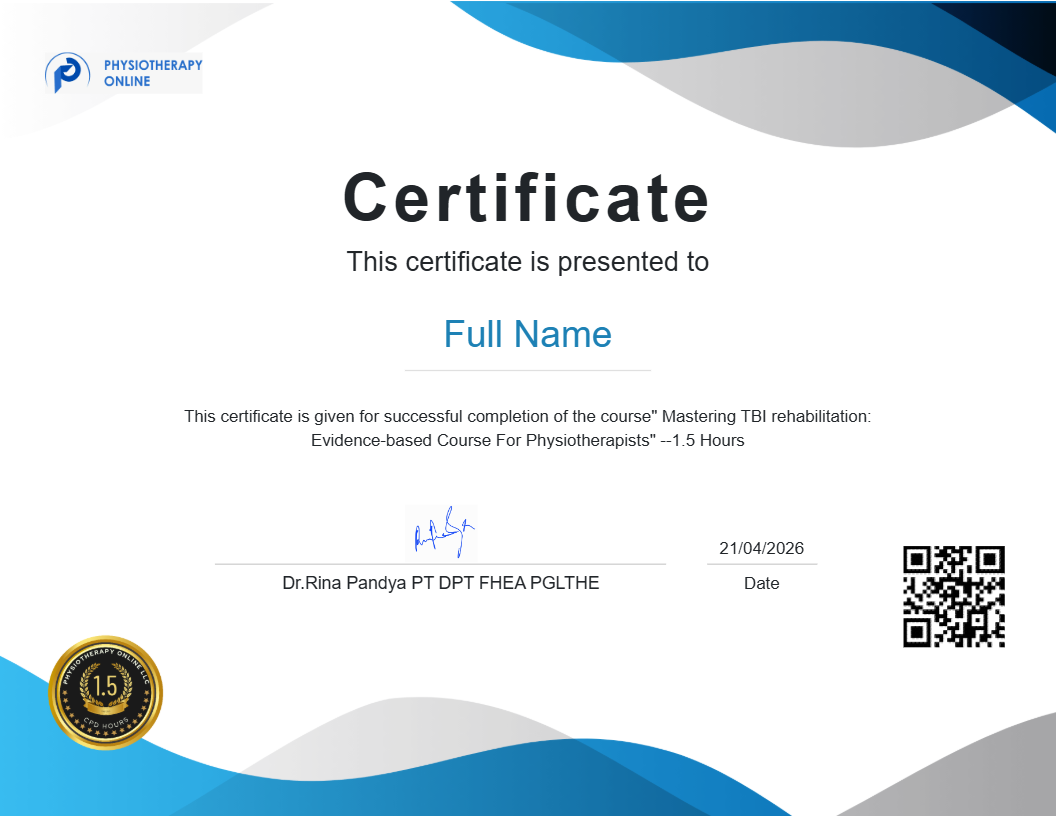
Certificate
A certificate is given at the end of the course.
The course will be available 30 Day
Mastering TBI rehabilitation: Evidence-based Course For Physiotherapists
Author
Physiotherapy Online
About Physiotherapy Online
Physiotherapy Online is a physiotherapist-owned educational company with a vision to create an ensemble of international educators to cater to undergraduate, postgraduate physiotherapy students as well as post professionals who are keen to advance or refesh their existing knowledge in varied specialities.
As every student has a unique approach to learning, we have therefore created a library of bite sized chapters which may be accessed as an individual module or a course as a whole; self study webinars; live workshops for those who would like to get an in-person hands on immersive experience and audio books for those on the go.
