
Functional Neurological Disorder in Children (Part 1): Recognition and Clinical Reasoning

Author
Physiotherapy Online
About Physiotherapy Online
Physiotherapy Online is a physiotherapist-owned educational company with a vision to create an ensemble of international educators to cater to undergraduate, postgraduate physiotherapy students as well as post professionals who are keen to advance or refesh their existing knowledge in varied specialities.
As every student has a unique approach to learning, we have therefore created a library of bite sized chapters which may be accessed as an individual module or a course as a whole; self study webinars; live workshops for those who would like to get an in-person hands on immersive experience and audio books for those on the go.
This evidence-informed CPD course explores the assessment and management of paediatric Functional Neurological Disorder (FND) in children and adolescents. Designed for physiotherapists and rehabilitation professionals, the course provides practical, evidence-informed strategies for clinical assessment, differential diagnosis, functional movement retraining and multidisciplinary rehabilitation.
Learn to recognise positive clinical signs of FND, assess functional weakness, gait disturbances, tremor, dystonia, jerks and functional seizures, and distinguish FND from other neurological conditions. The course covers focused history-taking, clinical examination, red flags, coexisting conditions and current explanatory models of altered nervous-system functioning.
Explore practical approaches to paediatric FND rehabilitation, including automatic movement retraining, functional task practice, family education, functional-seizure safety, school reintegration and strategies to improve mobility, independence and participation. A complex clinical case study integrates assessment, treatment planning, risk management, escalation and relapse prevention.
Develop the confidence to communicate an FND diagnosis clearly and respectfully, apply a positive diagnostic approach based on clinical findings, and deliver coordinated, child-centred rehabilitation that supports meaningful functional recovery.
Ideal for physiotherapists, occupational therapists and other rehabilitation professionals seeking to enhance their knowledge and clinical skills in paediatric neurology, functional movement disorders and evidence-informed rehabilitation.
LEARNING OBJECTIVES
This course is designed to help participants:
- Understand paediatric FND as a disorder of nervous-system functioning and describe its symptom spectrum using clear and respectful language.
- Identify the positive clinical features that support an FND diagnosis, including variability, distractibility, internal inconsistency and preserved movement capacity.
- Use a focused assessment framework that incorporates history-taking, examination across contexts, functional-seizure assessment, safety screening and appropriate differential diagnosis.
- Translate assessment findings into a clear explanation and an evidence-informed rehabilitation plan centred on automatic movement and meaningful function.
- Coordinate participation-focused rehabilitation with the child, family, school and multidisciplinary team, including outcome review and relapse planning.
LEARNING OUTCOMES
By the end of this course, participants will be able to:
- Explain paediatric FND using clear, non-stigmatising language.
- Recognise common presentations and positive clinical signs.
- Complete a focused history, examination and safety screen.
- Differentiate FND features from red flags and common mimics.
- Apply evidence-informed physiotherapy and functional-seizure principles.
- Develop participation-focused rehabilitation goals with the child, family, school and MDT.
Duration: 2 Hours
TARGET AUDIENCE
This course is suitable for:
- Physiotherapists working in paediatrics, neurology, rehabilitation, community care or outpatient services.
- Occupational therapists and speech and language therapists involved in multidisciplinary FND care.
- Rehabilitation professionals supporting children with functional motor symptoms or functional seizures.
- Physiotherapy assistants and therapy students working under appropriate supervision.
- Healthcare professionals involved in mobility, school participation, functional-seizure safety or family-centred rehabilitation.
- Clinicians seeking a structured and evidence-informed introduction to paediatric FND.
Meet your presenter
Gehan Baalawi, BSc (Hons) Physiotherapy, Dip. Health & Social Care
Gehan Baalawi is a conscientious and forward-looking physiotherapist known for her evidence-based approach and emerging expertise in geriatric care. She holds a Bachelor of Science (Hons) in Physiotherapy from the University of the West of England (UWE),Bristol, and a Diploma in Health & Social Care from SGS College—credentials that underscore her dedication to delivering holistic, person-centred care.
Her recent academic research explored the effects of deep slow breathing (DSB) versus spontaneous breathing on pressure pain thresholds in asymptomatic adults, measured using algometry on the tibialis anterior muscle. This work reflects her keen interest in non-invasive interventions that promote physiological resilience and pain modulation.
Clinically and academically, Gehan is invested in the use of validated screening tools, comprehensive assessment strategies, and integrated, multi-component interventions to support positive patient outcomes. She is deeply committed to empowering healthcare professionals by translating current research into practical, impactful physiotherapy education.
Complementing her clinical expertise, Gehan has completed additional training in Mental Health Care Fundamentals, Leadership Skills, and Well-Being and Self-Care—reinforcing her commitment to safe, inclusive, and compassionate practice. She is a registered member of both the Health and Care Professions Council (HCPC) and the Chartered Society of Physiotherapy (CSP) in England.
Disclaimer: Our online physiotherapy CPD courses meet the criteria and guidelines for CPD (Continuing Professional Development). The CPD hours indicated on the certificate contribute towards fulfilling professional standards and requirements necessary for CPD audits conducted by the HCPC and AHPRA. These CPD hours are important for maintaining physiotherapy registration and ensuring compliance with the CPD audit and physiotherapy registration renewal processes. Our courses are recognized as valuable continuing education resources across the UK, Australia, New Zealand, and throughout Asia and the Middle East.
Course program


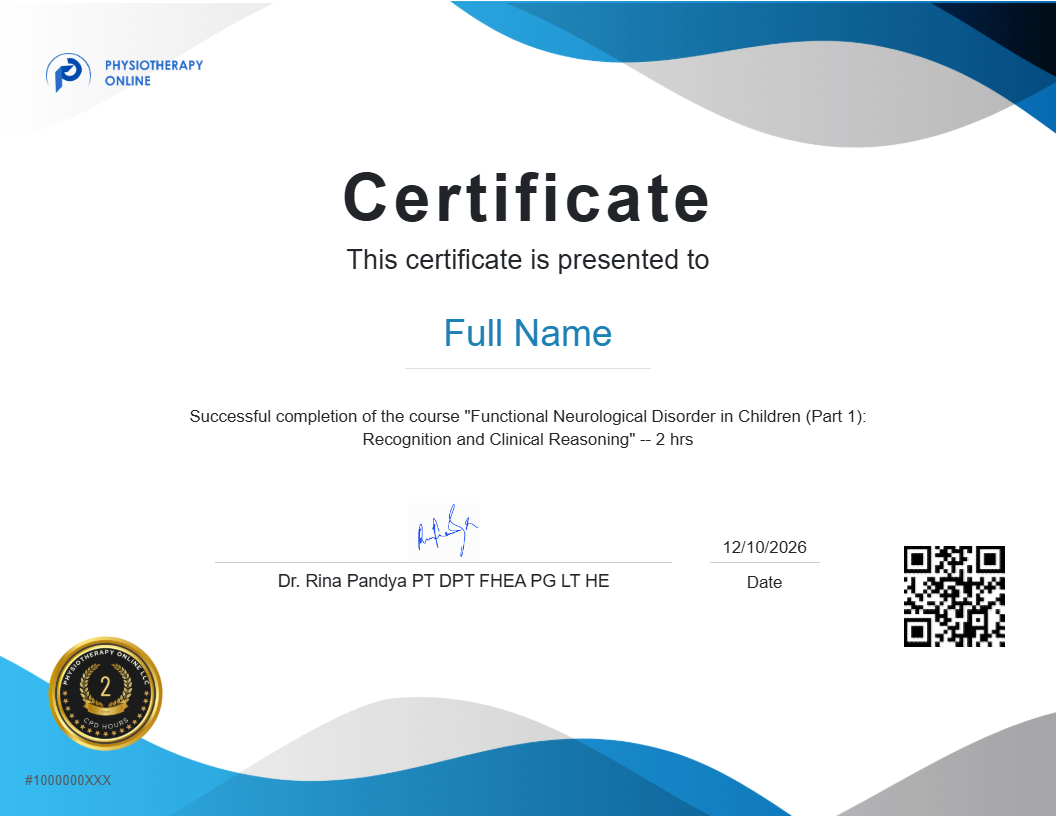
Certificate
A certificate is given at the end of the course.
The course will be available 30 Day
Functional Neurological Disorder in Children (Part 1): Recognition and Clinical Reasoning
Author
Physiotherapy Online
About Physiotherapy Online
Physiotherapy Online is a physiotherapist-owned educational company with a vision to create an ensemble of international educators to cater to undergraduate, postgraduate physiotherapy students as well as post professionals who are keen to advance or refesh their existing knowledge in varied specialities.
As every student has a unique approach to learning, we have therefore created a library of bite sized chapters which may be accessed as an individual module or a course as a whole; self study webinars; live workshops for those who would like to get an in-person hands on immersive experience and audio books for those on the go.
